The following is the Fatwa of Sheikh ul Hind, Maulana Mahmood Hasan who
was imprisoned by the British in Malta for 3 years due to him sticking
to the truth and not disowning the Uthmani Khilafah. Shaikhul Hind and
his student Maulana Hussain Ahmad Madni (later klnown as Shaikhul
Islam) were arrested by the Sharif Hussein in Hijaz (Makkah) on 23rd
Safar 1335 (19th December 1916). They were sent to Malta via Cairo by a
ship on 29th Rabbi al-Thanni 1335 (22nd February 1917) and clamped in
the prison by the British for 3 years and 4 months. They were released
and reached Bombay on 8th June 1920 (21st Ramadhan 1338). This time of
returning from Malta synchronized with the period of the beginning of
the Khilafat Movement in India.
Sheikh ul Hind was the head of Dar al ulum Deoband at his time, he directly supported the Khilafah and worked hard for its maintenance. He had met the Wali (governor) of the Khilafah in Makkah and the assistants of the Khalifah. The Wali gave documents to the Sheikh to help in the struggle of Muslims of India against the tyranny of the British. The foremost of these documents was an appeal from the Wali to the Muslims of India. In his appeal, the Wali of Makkah praised Sheikh ul Hind for launching the struggle against the colonial British rule and also exhorted Muslims of India to extend their full support. He also assured the Muslims of India of material support from this movement from the Khilafah. The document written by the Governor of Makkah is known in history as Ghalib Namah. After performing Hajj in 1334 AH (1915 CE), the Sheikh also met with Anwar Pasha and Jamal Pasha, who were officials of the Khilafah. Anwar Pasha too wrote a letter of appeal for the Muslims of India, appreciating their constant struggle against the British tyranny. The wording of the letter was similar to the Ghalib Namah, assuring the material support of the Uthmani Khilafah to the Muslims of India in their struggle against the British. The letter also exhorted all citizens and employees of the Uthmani Khilafah to have full confidence in Sheikh ul Hind and prove men and material support to his movement. Copies of these letters were made, smuggled to India in the face of all the challenges posed by the British intelligence services and later distributed in the whole of Yaghestan.
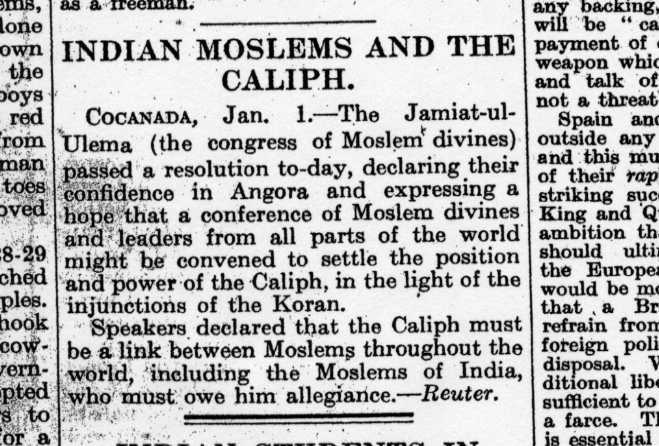
Most of the Ulema in India stood up for the issue of the Khilafah in the beginning of the 20th Century, unfortunately today it has become forgotten by many.
The text of the Fatwa demonstrates how Sheikh ul Hind used to see the duty of Khilafah and his view towards co-operating with the colonialists.
The Fatwa:
Questions: What do the Ulama and Mufti have to say on the following issues?
1) Due to extra expenditure, the managements of Madaris take grants from the British government. In view of their decision of non-cooperation with the British government, is it permissible or not to take such grants from the government?
2) Is the acceptance of government stipend, given to students and to those who hold titles in the British government, permissible?
3) Is it permissible for students to leave such, Madaris without giving any information to their parents, or guardians, or in the face of their opposition to such acts?
4) We are duty bound to provide sustenance to our wives, children and aged parents. Is it necessary to leave this duty for the cause of establishing Khilafat?
5) There are Madaris that accept grants from the government, or from the head of the provincial government, who are opposed to the cause of Khilafat and the non-cooperation movement. Is it permissible to teach, or study, or accept any sort of administrative or preaching job in such institutions?
6) Is it permissible to take money from the Khilafat fund for fulfilling bare personal necessities or for fulfilling requirements of those whose well-being is one’s duty?
7) What sort of relationship one should maintain with those who are government servants or those who are employees of a Madrasa that gets grants from the government?
8) In relation to the establishment of the Khilafat or non-cooperation movement against the British government, is it permissible to take help and cooperation (whether moral or material) from Hindus?
9) The money from the continual fund of the Aligarh School or its building that costs around forty hundred thousands rupees. The cost of library, books and peripheries would be thousands rupees. Is it or not duty of the members of the Madrasa to use them properly and protect them from getting damaged?
10) Is it necessary for students engaged in acquiring contemporary English education to acquire religious education too so that when they complete their formal education, they could impart education to others? Or is it necessary for such students to strive and make Khilafat and non-cooperation movements successful? In short, is the attainment of religious education preferable or participation in the Khilafat movement and the non-cooperation movement?
Answers
In the name of Allah, the Beneficent, the Merciful Praised be to Allah and peace and blessings on the chosen one.
Heart is after all a heart and not a brick or a stone that cannot be overwhelmed by grief, We will cry a thousands time, why any shall disturb us?
Before answers of these questions are given, it is very important that every true Muslim should come out from the prevailing narrow thinking and think in terms of the great blessings of Allah that have been bestowed upon us as Muslims. If we look deeply at the present situation in the light of our past experiences, it would be clear that the greatest and most precious wealth of Muslims is their Imaan (faith). And to protect it with all their might is the first duty of every Muslim. With what a cunning trick, shamelessness and deceitful acts this wealth is stolen away from us!
The enemies of Islam have left no stone unturned to strike against and harm the honour and prestige of Islam. Iraq, Palestine and Syria that were won over by the Prophet’s companions and his followers, after innumerous sacrifices, have once again become the targets of greed of the enemy of Islam. The honour of Khilafat is in tatters. Khalifat-ul-Muslimin (Muslim Caliph), who used to unite the entire community on this planet; who as vice-regent of Allah on this earth used to implement the universal law of Islam; who used to protect the rights and interests of Muslims and who used to preserve and ensure that the glory of the words of the Creator of this universe be preserved and implemented, has been surrounded by the enemies and made redundant.
“The mountain of problems that has been put on my shoulder, if the same were kept on the day, it would turn into the night!”
The flag of Islam is flying low today. The soul of Hazrat Abu Ubaidah (RA), Sa’d Bin Abi Waqas (RA), Khalid Bin Walid (RA) and Abu Ayub Ansari (RA) is restless today. Why is it so? It is because Muslims have lost their dignity, their honour and their self-respect. The bravery and religious fervour that was their forte and heritage, they have lost these due to their ignorance and over-indulgence in frivolities.
It is not only that in times of difficulty a Muslim does not help a fellow Muslim, but tragically that the eagerness to earn the goodwill and friendship of a kufir has led a brother to chop the head of his own brother. Muslims have drunk the blood of Muslims. Muslims have dipped their hands in the blood of their own brothers.
O’ the Children of Islam! And O’ the lovers of this great Nation! You know it better than me that the thunder and fire that burnt the tents in Islamic world and put on fire the castle of Islamic Khilafat were derived from the hot blood of Arabs and Indians. And the power of wealth with which the Christians have succeeded in subjugating Muslim nations, a great chunk of it was from your hard labour.
Thus, is there any stupid and thick-headed Muslim who won’t understand the results of cooperation with the Christians? And this too in a situation when a drowning man seeks the help of a haystack and looks for a way out for cooperation that would save him from drowning?
O’ my people! This is not the time for discourse and discussion in things like supposition and supererogation, but it is the time to act with Islamic spirit for the honour and prestige of our religion. I fear that differences, big or small, among Ulama might dampen (our) spirit and courage. I am not asking you to pick up sword and go to Iraq and Syria for Jihad against the enemies of Islam and fight alongside your brethren there. My only request is not to strengthen the hands of enemies of Islam and follow the following Commandments of Allah with courage and sincerity:
“O’ ye who believe! Take not the Jews and the Christians for friends. They are friends one to another. He among you who taketh them for friends is (one) of them….” (Surah Al-Maida, Verse:51)
“Let not the believers take disbelievers for their friends in preference to believers. Whose doth that hath no connection with Allah…..” (Surah A’le Imran, Verse:28)
“Bear unto the hypocrites the tidings that for them there is a painful doom; those who choose disbelievers for their friends instead of believers! Do they look for power at their hands? Lo! All power belongs to Allah.” (Surah Nisaa’, Verse: 138-139)
“O ye who believe! Choose not disbelievers for (your) friends in place of believers. Would ye give Allah a clear warrant against you?” (Surah Nisaa’,Verse: 144)
“O ye who believe! Choose not for friends such of those who received the Scriptures before you, and of the disbelievers, as make a jest and sport of your religion. But keep your duty to Allah if ye are true believers.” (Surah Al Maida, Verse: 57)
"Thou seest many of them making friends with those who disbelieves. Surely ill for them is that which they themselves send on before them: that Allah will be worth with them and in the doom they will abide. If they believe in Allah and the Prophet and that which is revealed unto him, they would not choose them for their friends. But many of them are of evil conduct”. (Surah Al Maida, Verse: 8—81)
“Thou wilt not find folk who believe in Allah and the Last Day loving those who oppose Allah and His messenger, even though they be their fathers or their sons or their brethren or their clan. As for such, He hath written faith upon their hearts and hath strengthened them with a Spirit of Him, and He will bring them into Gardens underneath which rivers flow wherein they will abide. Allah is well pleased with them, and they are well pleased with Him. They are Allah’s party. Lo! Is it not Allah’s party who the successful?” (Surah Al Mujaadalah, Verse:22)
“O ye who believe! Choose not My enemy and your enemy for friends. Do ye give them friendship when they disbelieve in that truth which hath come unto you..” (Surah Al Mumtahana, Verse: 1)
There are plenty of verses in the Qur’an to this effect and the collection of all such is not intended here. However, it should be clear that I have translated ‘Auliya’ as ‘helper’ and ‘friend’ here. The meaning and explanation is derived from the interpretation of stalwarts of Tafseer such as Imam Ibn Jareer Tabri, Hafiz A’maduddin Bin Kathir and Imam Fakhruddin Ra’zi. My purpose here is to explain only this much that under ‘non-cooperation’ both not to help them as well as not to take help from them is included. Thus: the answer to your 1st and 2nd question will be that the aids taken from the British government for Madaris and the scholarship taken by students are to be abandoned. And in the taking their decision of non-cooperation, students are not to depend on the permission of their parents, rather it is their rights that with due respect and honour they should prompt their parents to agree with them for non-cooperation against the British government. The dilemma that students are currently encountering was also faced by Muslims during the Prophet’s time. They also put this question before the Prophet about how could they possibly totally snap the relationship with Kafir (non-believers). For if they did so, they would be separated from their parents, brothers, sisters, and other relatives. Their businesses would be destroyed and their property would go waste. And thus their villages would be ruined. The answer to their questions were given in the following verse by the almighty Allah:
“Say: if your fathers, your sons, and your brethren, and your wives, and your tribe, and the wealth ye have acquired, and merchandise for which ye fear that there will be no sale, and dwelling ye desire are dearer to you than Allah and His messenger and striving in His way: then wait till Allah brings His command to pass. Allah guideth not wrongdoing folk.” (Surah Al Tawbah, Verse:24)
Sometimes there is fear in the heart that if the movements that are going on all over the country failed and the government remained adamant, there are chances of great losses. These kinds of views were present then also. Thus the glorious Qur’an says: “ We fear lest a change of fortune befall us!” (i.e. Hypocrites say that our friendly relationship with Jews is for reasons that if in the course of time and with the turn of events Muhammed (PBUH) fails in his mission and Jews become victorious, we would be faced with great difficulties then.)
Almighty Allah answers them in the following verse:
“…And it may happen that Allah will vouchsafe (unto thee) the victory, or a commandment from His presence. Then will they repent fro their secret thoughts.” (Surah Al Maida, Verse: 52)
O’ my friends! Then catch hold of Allah’s Commandments and, believing in Him only, remain firm in your goals and stick to non-cooperation with the British. Whatever support and help of which you are capable and you can give to Islam and Islamic people, do not delay n extending it. The time is such whereby you cannot ignore it and let it go.
It is good fortune that the vast majority of Hindus is looking forward to your cooperation and support. The incident of Jalianwala Bagh in Punjab and the desire for the self-government have made the time propitious for non-cooperation with the British Christians. It is also heard that the Sikh League has decided in favour of non-cooperation. Keep the eye towards Allah and act when the time is propitious. Your friend and helper is only Allah! If the people of another community come forward and help in your pious mission and extend support in crisis, you should cooperate with them as well. You should be equally courteous to them; rather you should act more generously. The Glorious Qur’an says:
“ Allah forbidden you not those who warred not against you on account of religion and drove you not out from your homes, that ye should show kindness and deal justly with them. Lo! Allah loveth the just dealers. Allah forbidden you only those who warred against you on account of religion and have driven you out from your homes and helper to drive you out, that ye make friends of them. Whosoever make friends of them (All) such are wrongdoers.” (Surah Mumtahanah, Verse:8-9)
It would be wise to caution here that cooperation and relationship with Hindus does not mean that Muslims should mould their religion commandments to fit to the ways of Kufr. If they do it, it would be like earning sins in exchange for piousness.
My purpose is that you act upon the call of non-cooperation with the British government very sincerely. While doing it, have faith in Allah only. And those students who do not have some other obligatory work to do should participate in propagating this movement. Those who have obligation towards wife, children and parents should participate to the extent that their participation does not become the cause of neglect to heir family. And if some one strives to aid and protect Khilafat, and Khilafat Committee proposes a sum from its donations to fulfil his need, it is permissible for the person to take it.
In short, cooperation with Kuffar is not permissible. It is better to keep oneself and others away from the cooperation of the British. Muslims should take away their minds from everything and put their trust in Allah in whose hand the fate of both a beggar and a king rests.
Prudence, in my vision, is that the friends in destiny should choose the eternal beloved first
Then he should go ahead, enslaving in the curl lock of that beloved without caring for the consequences.
Now, I would wind up this argument with my petition and request that I am not a Mufti. Yet, I hope that my arguments would answer some of your questions. Along with the care and wellbeing of the building of the Aligarth College and its library, your conscience should also weigh and compare the value of Constantinople, Syria, Palestine and Iraq.
In the end, I deem it necessary to say here that to make non-cooperation movement a success depends upon our own moves. We should not do anything that would prove injurious to peace or cause blood letting. And this is the advice of all the intellectuals. We should imbibe this advise, otherwise there would be fear of loss instead of benefit.
Let us pray to Allah, the source of all honour, from the core of our heart that He should not dishonour the Ummah, should not make us the target of Kuffar and help us in all our endeavour and good deeds.
Wassalam,
Mahmood
Your well-wisher and seeker of Allah’s forgiveness.
16th Safar 1339 (30th October 1920)
Sheikh ul Hind was the head of Dar al ulum Deoband at his time, he directly supported the Khilafah and worked hard for its maintenance. He had met the Wali (governor) of the Khilafah in Makkah and the assistants of the Khalifah. The Wali gave documents to the Sheikh to help in the struggle of Muslims of India against the tyranny of the British. The foremost of these documents was an appeal from the Wali to the Muslims of India. In his appeal, the Wali of Makkah praised Sheikh ul Hind for launching the struggle against the colonial British rule and also exhorted Muslims of India to extend their full support. He also assured the Muslims of India of material support from this movement from the Khilafah. The document written by the Governor of Makkah is known in history as Ghalib Namah. After performing Hajj in 1334 AH (1915 CE), the Sheikh also met with Anwar Pasha and Jamal Pasha, who were officials of the Khilafah. Anwar Pasha too wrote a letter of appeal for the Muslims of India, appreciating their constant struggle against the British tyranny. The wording of the letter was similar to the Ghalib Namah, assuring the material support of the Uthmani Khilafah to the Muslims of India in their struggle against the British. The letter also exhorted all citizens and employees of the Uthmani Khilafah to have full confidence in Sheikh ul Hind and prove men and material support to his movement. Copies of these letters were made, smuggled to India in the face of all the challenges posed by the British intelligence services and later distributed in the whole of Yaghestan.
Most of the Ulema in India stood up for the issue of the Khilafah in the beginning of the 20th Century, unfortunately today it has become forgotten by many.
The text of the Fatwa demonstrates how Sheikh ul Hind used to see the duty of Khilafah and his view towards co-operating with the colonialists.
The Fatwa:
Questions: What do the Ulama and Mufti have to say on the following issues?
1) Due to extra expenditure, the managements of Madaris take grants from the British government. In view of their decision of non-cooperation with the British government, is it permissible or not to take such grants from the government?
2) Is the acceptance of government stipend, given to students and to those who hold titles in the British government, permissible?
3) Is it permissible for students to leave such, Madaris without giving any information to their parents, or guardians, or in the face of their opposition to such acts?
4) We are duty bound to provide sustenance to our wives, children and aged parents. Is it necessary to leave this duty for the cause of establishing Khilafat?
5) There are Madaris that accept grants from the government, or from the head of the provincial government, who are opposed to the cause of Khilafat and the non-cooperation movement. Is it permissible to teach, or study, or accept any sort of administrative or preaching job in such institutions?
6) Is it permissible to take money from the Khilafat fund for fulfilling bare personal necessities or for fulfilling requirements of those whose well-being is one’s duty?
7) What sort of relationship one should maintain with those who are government servants or those who are employees of a Madrasa that gets grants from the government?
8) In relation to the establishment of the Khilafat or non-cooperation movement against the British government, is it permissible to take help and cooperation (whether moral or material) from Hindus?
9) The money from the continual fund of the Aligarh School or its building that costs around forty hundred thousands rupees. The cost of library, books and peripheries would be thousands rupees. Is it or not duty of the members of the Madrasa to use them properly and protect them from getting damaged?
10) Is it necessary for students engaged in acquiring contemporary English education to acquire religious education too so that when they complete their formal education, they could impart education to others? Or is it necessary for such students to strive and make Khilafat and non-cooperation movements successful? In short, is the attainment of religious education preferable or participation in the Khilafat movement and the non-cooperation movement?
Answers
In the name of Allah, the Beneficent, the Merciful Praised be to Allah and peace and blessings on the chosen one.
Heart is after all a heart and not a brick or a stone that cannot be overwhelmed by grief, We will cry a thousands time, why any shall disturb us?
Before answers of these questions are given, it is very important that every true Muslim should come out from the prevailing narrow thinking and think in terms of the great blessings of Allah that have been bestowed upon us as Muslims. If we look deeply at the present situation in the light of our past experiences, it would be clear that the greatest and most precious wealth of Muslims is their Imaan (faith). And to protect it with all their might is the first duty of every Muslim. With what a cunning trick, shamelessness and deceitful acts this wealth is stolen away from us!
The enemies of Islam have left no stone unturned to strike against and harm the honour and prestige of Islam. Iraq, Palestine and Syria that were won over by the Prophet’s companions and his followers, after innumerous sacrifices, have once again become the targets of greed of the enemy of Islam. The honour of Khilafat is in tatters. Khalifat-ul-Muslimin (Muslim Caliph), who used to unite the entire community on this planet; who as vice-regent of Allah on this earth used to implement the universal law of Islam; who used to protect the rights and interests of Muslims and who used to preserve and ensure that the glory of the words of the Creator of this universe be preserved and implemented, has been surrounded by the enemies and made redundant.
“The mountain of problems that has been put on my shoulder, if the same were kept on the day, it would turn into the night!”
The flag of Islam is flying low today. The soul of Hazrat Abu Ubaidah (RA), Sa’d Bin Abi Waqas (RA), Khalid Bin Walid (RA) and Abu Ayub Ansari (RA) is restless today. Why is it so? It is because Muslims have lost their dignity, their honour and their self-respect. The bravery and religious fervour that was their forte and heritage, they have lost these due to their ignorance and over-indulgence in frivolities.
It is not only that in times of difficulty a Muslim does not help a fellow Muslim, but tragically that the eagerness to earn the goodwill and friendship of a kufir has led a brother to chop the head of his own brother. Muslims have drunk the blood of Muslims. Muslims have dipped their hands in the blood of their own brothers.
O’ the Children of Islam! And O’ the lovers of this great Nation! You know it better than me that the thunder and fire that burnt the tents in Islamic world and put on fire the castle of Islamic Khilafat were derived from the hot blood of Arabs and Indians. And the power of wealth with which the Christians have succeeded in subjugating Muslim nations, a great chunk of it was from your hard labour.
Thus, is there any stupid and thick-headed Muslim who won’t understand the results of cooperation with the Christians? And this too in a situation when a drowning man seeks the help of a haystack and looks for a way out for cooperation that would save him from drowning?
O’ my people! This is not the time for discourse and discussion in things like supposition and supererogation, but it is the time to act with Islamic spirit for the honour and prestige of our religion. I fear that differences, big or small, among Ulama might dampen (our) spirit and courage. I am not asking you to pick up sword and go to Iraq and Syria for Jihad against the enemies of Islam and fight alongside your brethren there. My only request is not to strengthen the hands of enemies of Islam and follow the following Commandments of Allah with courage and sincerity:
“O’ ye who believe! Take not the Jews and the Christians for friends. They are friends one to another. He among you who taketh them for friends is (one) of them….” (Surah Al-Maida, Verse:51)
“Let not the believers take disbelievers for their friends in preference to believers. Whose doth that hath no connection with Allah…..” (Surah A’le Imran, Verse:28)
“Bear unto the hypocrites the tidings that for them there is a painful doom; those who choose disbelievers for their friends instead of believers! Do they look for power at their hands? Lo! All power belongs to Allah.” (Surah Nisaa’, Verse: 138-139)
“O ye who believe! Choose not disbelievers for (your) friends in place of believers. Would ye give Allah a clear warrant against you?” (Surah Nisaa’,Verse: 144)
“O ye who believe! Choose not for friends such of those who received the Scriptures before you, and of the disbelievers, as make a jest and sport of your religion. But keep your duty to Allah if ye are true believers.” (Surah Al Maida, Verse: 57)
"Thou seest many of them making friends with those who disbelieves. Surely ill for them is that which they themselves send on before them: that Allah will be worth with them and in the doom they will abide. If they believe in Allah and the Prophet and that which is revealed unto him, they would not choose them for their friends. But many of them are of evil conduct”. (Surah Al Maida, Verse: 8—81)
“Thou wilt not find folk who believe in Allah and the Last Day loving those who oppose Allah and His messenger, even though they be their fathers or their sons or their brethren or their clan. As for such, He hath written faith upon their hearts and hath strengthened them with a Spirit of Him, and He will bring them into Gardens underneath which rivers flow wherein they will abide. Allah is well pleased with them, and they are well pleased with Him. They are Allah’s party. Lo! Is it not Allah’s party who the successful?” (Surah Al Mujaadalah, Verse:22)
“O ye who believe! Choose not My enemy and your enemy for friends. Do ye give them friendship when they disbelieve in that truth which hath come unto you..” (Surah Al Mumtahana, Verse: 1)
There are plenty of verses in the Qur’an to this effect and the collection of all such is not intended here. However, it should be clear that I have translated ‘Auliya’ as ‘helper’ and ‘friend’ here. The meaning and explanation is derived from the interpretation of stalwarts of Tafseer such as Imam Ibn Jareer Tabri, Hafiz A’maduddin Bin Kathir and Imam Fakhruddin Ra’zi. My purpose here is to explain only this much that under ‘non-cooperation’ both not to help them as well as not to take help from them is included. Thus: the answer to your 1st and 2nd question will be that the aids taken from the British government for Madaris and the scholarship taken by students are to be abandoned. And in the taking their decision of non-cooperation, students are not to depend on the permission of their parents, rather it is their rights that with due respect and honour they should prompt their parents to agree with them for non-cooperation against the British government. The dilemma that students are currently encountering was also faced by Muslims during the Prophet’s time. They also put this question before the Prophet about how could they possibly totally snap the relationship with Kafir (non-believers). For if they did so, they would be separated from their parents, brothers, sisters, and other relatives. Their businesses would be destroyed and their property would go waste. And thus their villages would be ruined. The answer to their questions were given in the following verse by the almighty Allah:
“Say: if your fathers, your sons, and your brethren, and your wives, and your tribe, and the wealth ye have acquired, and merchandise for which ye fear that there will be no sale, and dwelling ye desire are dearer to you than Allah and His messenger and striving in His way: then wait till Allah brings His command to pass. Allah guideth not wrongdoing folk.” (Surah Al Tawbah, Verse:24)
Sometimes there is fear in the heart that if the movements that are going on all over the country failed and the government remained adamant, there are chances of great losses. These kinds of views were present then also. Thus the glorious Qur’an says: “ We fear lest a change of fortune befall us!” (i.e. Hypocrites say that our friendly relationship with Jews is for reasons that if in the course of time and with the turn of events Muhammed (PBUH) fails in his mission and Jews become victorious, we would be faced with great difficulties then.)
Almighty Allah answers them in the following verse:
“…And it may happen that Allah will vouchsafe (unto thee) the victory, or a commandment from His presence. Then will they repent fro their secret thoughts.” (Surah Al Maida, Verse: 52)
O’ my friends! Then catch hold of Allah’s Commandments and, believing in Him only, remain firm in your goals and stick to non-cooperation with the British. Whatever support and help of which you are capable and you can give to Islam and Islamic people, do not delay n extending it. The time is such whereby you cannot ignore it and let it go.
It is good fortune that the vast majority of Hindus is looking forward to your cooperation and support. The incident of Jalianwala Bagh in Punjab and the desire for the self-government have made the time propitious for non-cooperation with the British Christians. It is also heard that the Sikh League has decided in favour of non-cooperation. Keep the eye towards Allah and act when the time is propitious. Your friend and helper is only Allah! If the people of another community come forward and help in your pious mission and extend support in crisis, you should cooperate with them as well. You should be equally courteous to them; rather you should act more generously. The Glorious Qur’an says:
“ Allah forbidden you not those who warred not against you on account of religion and drove you not out from your homes, that ye should show kindness and deal justly with them. Lo! Allah loveth the just dealers. Allah forbidden you only those who warred against you on account of religion and have driven you out from your homes and helper to drive you out, that ye make friends of them. Whosoever make friends of them (All) such are wrongdoers.” (Surah Mumtahanah, Verse:8-9)
It would be wise to caution here that cooperation and relationship with Hindus does not mean that Muslims should mould their religion commandments to fit to the ways of Kufr. If they do it, it would be like earning sins in exchange for piousness.
My purpose is that you act upon the call of non-cooperation with the British government very sincerely. While doing it, have faith in Allah only. And those students who do not have some other obligatory work to do should participate in propagating this movement. Those who have obligation towards wife, children and parents should participate to the extent that their participation does not become the cause of neglect to heir family. And if some one strives to aid and protect Khilafat, and Khilafat Committee proposes a sum from its donations to fulfil his need, it is permissible for the person to take it.
In short, cooperation with Kuffar is not permissible. It is better to keep oneself and others away from the cooperation of the British. Muslims should take away their minds from everything and put their trust in Allah in whose hand the fate of both a beggar and a king rests.
Prudence, in my vision, is that the friends in destiny should choose the eternal beloved first
Then he should go ahead, enslaving in the curl lock of that beloved without caring for the consequences.
Now, I would wind up this argument with my petition and request that I am not a Mufti. Yet, I hope that my arguments would answer some of your questions. Along with the care and wellbeing of the building of the Aligarth College and its library, your conscience should also weigh and compare the value of Constantinople, Syria, Palestine and Iraq.
In the end, I deem it necessary to say here that to make non-cooperation movement a success depends upon our own moves. We should not do anything that would prove injurious to peace or cause blood letting. And this is the advice of all the intellectuals. We should imbibe this advise, otherwise there would be fear of loss instead of benefit.
Let us pray to Allah, the source of all honour, from the core of our heart that He should not dishonour the Ummah, should not make us the target of Kuffar and help us in all our endeavour and good deeds.
Wassalam,
Mahmood
Your well-wisher and seeker of Allah’s forgiveness.
16th Safar 1339 (30th October 1920)